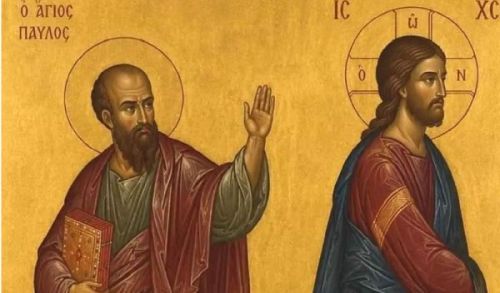
If you ask most Western Christians today, they’ll probably tell you they're following Jesus—but they’re wrong. They are not following Jesus—they are following Paul.
Much of what they believe and do does not, in fact, actually trace back to Jesus, but to one of his most enthusiastic followers—a man who never met him, and converted only after Jesus’s supposed resurrection.
In today’s essay, I want to examine how this zealous convert destroyed the religion of Jesus and turned it into the religion about Jesus—partly through what he did himself, but mostly through what others did with his letters.
Before we can talk about what Paul did to the religion of Jesus, it’s helpful to layout the basic facts that we actually know about Paul. Paul was a Jewish man from
somewhere in the Greek-speaking world outside Judea, born early in the first century. That makes him roughly a contemporary of Jesus, though the two never met.
Almost everything we can say about him with confidence comes from his own letters (the colorful details most Christians carry around, from the road to Damascus to the name change from Saul, come from Acts, written decades after his death and best handled with skepticism).
1
Who Was Paul?
By his own account he was circumcised on the eighth day, came from the tribe Benjamin, and was more devoted to the traditions of his ancestors than most people his age (Phil 3:5–6; Gal 1:14). He also calls himself a Pharisee, which we have only his word for, offered in the middle of a list of credentials meant to outrank rivals.
He was also, by his own account, an enemy of the spreading Jesus movement a Jesus's execution. He says he persecuted the communities of Jesus followers violently and tried to destroy them (Gal 1:13; 1 Cor 15:9), though he never tells us why.
Then he had an experience that turned him around. He describes it as God revealing his Son to him (Gal 1:16), as having “seen Jesus our Lord” (1 Cor 9:1), and has the risen Jesus appearing to him last of all, after Peter, James, and the others. Corinthians 15:5–8).
Now, whether Jesus actually appeared to Paul is a question of faith, and history can't settle it. What history can say is that Paul believed it, that he ranked his vision alongside the experiences of people who had actually known Jesus, and tit turned an aggressive persecutor of the early movement into an aggressive missionary.
But, importantly, Paul never claims to have known Jesus in the flesh. He never she heard Jesus teach, watched him heal, ate with him, or set foot in Galilee while Jesus was alive. His only firsthand contact with the people who had was a fifteen day stay with Peter and a brief meeting with James, Jesus’s brother (Gal 1:18–19)Everything else he knew about Jesus’s life presumably came to him secondhand and, as we’ll see, he showed remarkably little interest in most of it.
His surviving letters (seven of them, by broad scholarly agreement, a number we come back to) date to roughly 50–60 CE, two decades after the crucifixion and well before Mark, the earliest gospel, written around 70. They are the oldest Christian writings we have. The first Christian voice we still have, the one every later generation would use to read everything else, belongs to a man who never heard Jesus say a word.
What Paul preached and believed, as we’ll see, was very different from what Jesus preached—Jesus the actual person of history, the figure scholars call the historical Jesus.
Scholars try to separate the historical Jesus from the Christ of faith, the image of Jesus Christ that later followers built out of tradition, word of mouth, and eventually the writings of the New Testament, Paul’s letters being the very first of them. (I’ve written before about how scholars work out what Jesus likely said.)
1
The historical Jesus practiced what the theologian Howard Thurman called “the religion of Jesus,” a religion for people who live with their “backs against the wall.”
2
Jesus, like Paul, was a Jew—but unlike Paul lived in the ancient Jewish homeland the rural area around the Sea of Galilee. He was a craftsman from a small village living under Roman occupation and a Roman-backed ruler who taxed the countryside to pay for his building projects. He joined the movement of John the Baptist, a desert prophet who warned that God’s judgment was about to fall. After John was arrested, Jesus seems to picked up and continued John’s movement.
From John, Jesus carried forward the conviction that would shape everything he taught: God was about to act. The kingdom of God Jesus preached was a coming reality, where God would break into history and turn the present order upside-down. The first made last and the last made first. He expected it soon, within the lifetime of the people listening to him (Mark 9:1; 13:30). By any historical definition Jesus was an apocalyptic prophet.
The Religion of Jesus
He was also a spiritual leader, and the two roles fed each other. He prayed, often alone, and taught his followers to address God as a father. He had a reputation a healer and exorcist (whether the healings happened as described is a question of faith, but that people believed he performed them is well attested), and he ate with the people respectable religion kept at arm’s length.
When asked for the heart of the law, he gave two commandments, both straight out of the Torah: love God, and love your neighbor as yourself (Deut 6:4–5; Lev19:18). Scholars believe he wasn’t founding a new religion; he was calling his own people back to the one they already had.
And to the historical Jesus, if the kingdom was coming, you had to live like it was already here. That is where Jesus’s ethics come from. They are concrete, demanding, political, and overwhelmingly economic:
Blessed are you who are poor, and woe to you who are rich (Luke 6:20, 24).
Give to anyone who asks (Luke 6:30).
Love your enemies (Luke 6:27).
Sell what you have and give it to the poor (Mark 10:21).
It is easier for a camel to pass through the eye of a needle than for a rich man to enter the kingdom of God (Mark 10:25).
Forgive us our debts, as we forgive our debtors (Matt 6:12)—and in a Galilee where debt was how peasants lost their land, “debts” meant debts.
3
For Jesus, the coming kingdom and the ethics weren’t separate subjects, since how you treated the poor, the indebted, and the outcast was how you got ready for God’s arrival (
Mark 10:17–21
). In fact, it was how Jesus thought entry into the kingdom was granted. One gained access to the kingdom not by believing the right things, but by doing the right things.
He was a prophet announcing that God’s reign was coming, and a teacher insisting on how people had to live because of it. These were the teachings Paul heard about secondhand, if he heard about them at all. He kept the prophet and let the teacher fall away.
Paul and Jesus agreed on one big thing: the end was near. Like Jesus, Paul was an apocalyptic thinker who expected the world as he knew it to end within his own lifetime:
He told the Thessalonians that the Lord would come down from heaven and that believers still alive, Paul included, would be caught up to meet him in the air (1 Thess 4:15–17).
He told the Corinthians that time had grown short and the present world was passing away (1 Cor 7:29–31).
He told the Romans that salvation was nearer than when they first believed(Rom 13:11).
The difference was in who was coming. Jesus preached that God’s kingdom was on its way; Paul preached that Jesus himself was on his way back. That shift, from the message to the messenger, is where the religion about
Jesus begins.
What Jesus actually taught interested Paul remarkably little. Across seven letters he quotes Jesus a handful of times: on divorce (1 Cor 7:10–11), on preachers being supported by the communities they serve (1 Cor 9:14), and the words at the Last Supper (1 Cor 11:23–25). In the case of the preachers, he cites Jesus’s instruction and then announces in the very next verse that he won’t be following it (9:15). Nowhere does Paul mention Jesus’s parables, the blessings on the poor, the woe on the rich, or the camel and the needle. Even when he reaches the same conclusion Jesus did, that loving your neighbor as yourself sums up the whole l(Rom 13:9; Gal 5:14), he cites Leviticus, not Jesus.
The Religion About Jesus
To be fair to Paul, there are several possible explanations. He was writing to specific communities about specific problems, and Jesus’s teachings may not have spoken directly to them; had Paul set out to write a life of Jesus, he might well have included them. He may have assumed his readers already knew the teachings, and in a world where writing and sending a letter was slow, expensive work, he may not have wanted to spend precious space repeating them. Or he may not have known them, or not cared.
We’ll likely never know which. What we do know is that they aren’t there, and that whatever Paul’s reasons, the letters that became the earliest Christian scripture carried a Jesus whose teachings had been left out.
What Paul did fill his letters with was the cross and the empty tomb. He tells the Corinthians he decided to know nothing among them “except Jesus Christ, and him crucified” (1 Cor 2:2), and the tradition he passes on as being “of first importance” is that Christ died for our sins, was buried, and was raised on the third day (1 Cor 15:3–4).
When he spells out what it takes to be saved, the answer is to declare with your mouth that Jesus is Lord and believe in your heart that God raised him from the dead (Rom 10:9).
Set that next to Mark 10, where a man asks Jesus what he must do to inherit eternal life and Jesus tells him to keep the commandments, sell everything, and give the money to the poor. Jesus had pointed the way into the kingdom. In Paul, Jesus becomes the way in, and what you believe about him becomes the price of admission.
Again, to be fair to Paul, he likely didn’t come up with this on his own. The hymn in Philippians 2, describing Christ as a heavenly figure who emptied himself, took human form, and was exalted by God, is one most scholars think Paul was quoting from earlier followers. Architects work with the materials they’re given. But Paul is where we first see these materials assembled into a system: believer baptized into Christ’s death (Rom 6:3–4), living “in Christ,” making up his body, awaiting for his return. And Paul’s letters, carried from city to city and copied and read aloud, are what spread that system across the Mediterranean.
The strangest part is what the same apocalyptic conviction produced in each man. For Jesus, the coming kingdom was the reason to live by its rules now: forgive debts, give to anyone who asks, sell what you have. For Paul, the coming return was the reason to stay put. Because time was short, everyone should remain in condition they were in when God called them, married or single, circumcised or not, slave or free (1 Cor 7:17–24; whether he tells slaves who can gain their freedom to take it is one of the most argued-over sentences in the Greek New Testament.
To Christians living in the capital of the empire that had crucified Jesus, he wrote that they should submit to the governing authorities and pay their taxes (Rom13:1–7). Paul had ethics, and he could be sharp about money when it split a community; he scolded the better-off Corinthians for eating their fill at the Lord's Supper while poorer members went hungry (1 Cor 11:20–22).
But his ethics were about keeping small communities orderly while they waited and they drew on his own reasoning and the Jewish scriptures far more than anything Jesus said.
Jesus took the end of the world as a reason to turn the economy upside down, while Paul took it as a reason to wait the economy out.
Then there is faith. Paul’s line that a person is justified by faith in Christ and not works of the law (Gal 2:16) would one day become the foundation of Western Christianity. In its original setting, many scholars argue, “works of the law” mean the practices that marked Jews off from their neighbors, such as circumcision and the food laws, which some were pressing Gentile converts to adopt; Paul’s point was that Gentiles didn’t have to become Jews to belong.
4
That is a much narrower claim than the one later readers heard, and we’ll get to them. But the frame was Paul’s: a right relationship with God comes through trusting in what God did through Jesus’s death and resurrection, and the life and teaching that came before it are, at most, background.
Paul thought of himself as a Jew until the end. What he left behind, though, was a design for something else: a movement Gentiles could join without the Torah, centered on belief about Jesus’s death and return, with Jesus’s own teaching nearly absent.
Paul died in the 60s, executed by Rome, still waiting for a return that never came. He left behind a few letters and a scattering of small communities. His version of Jesus was just one voice among dozens in a noisy, quarrelsome first century, which rival groups held wildly different ideas about who Jesus was and what his death meant.
5
Nothing about Paul’s theology made it destined to win. It won because the people with power found it useful. The first step came within a generation of his death, when other writers began producing letters in his name. Six of the thirteen letters credited to Paul in the New Testament were most likely written by someone else, and they walk back much of what made the real Paul unsettling.
6
How the Powerful Made Use of Paul
By the second century, the fight was over who got to own Paul. Maricon built the first Christian canon out of one edited gospel and ten of Paul’s letters, and the proto-orthodox church answered by claiming Paul for itself, forgeries included until the New Testament it eventually assembled gave thirteen of its twenty-seven books to Paul’s name. When Constantine took up Christianity in the fourth century and later emperors made it the religion of the state, the religion about Jesus moved into the palace, and Paul came with it. Augustine finished the job for the Western church. He converted after reading few lines of Romans, and he spent the rest of his life turning Paul’s anguished passages about sin and flesh into the doctrine of original sin, the idea that every human being is born guilty and in need of the church’s sacraments to be saved. Augustine's Christianity cared enormously about the state of your soul and very little about the state of the empire.
Eleven centuries later, Martin Luther had his own breakthrough reading Romans and put justification by faith at the center of Protestant Christianity, ranking Paul's letters “far, far” above three of the four gospels, the ones holding most of what Jesus actually said.
The pattern holds right up to the present. American slaveholders’ preachers drew their texts from the household codes, and Howard Thurman, whose framework this essay is built on, wrote that his grandmother, who had been enslaved, would let him read her almost anything from the Bible except Paul’s letters, because the master’s minister had preached “slaves, be obedient” at her until she couldn’t bear to hear any of it.
7
(The verse he preached from came from a letter Paul almost certainly never wrote.) In 2018, the attorney general of the United States
cited in Romans 13 to defend separating migrant children from their parents at the border. Antonio Gramsci, the Italian Marxist who spent his final years in a fascist prison trying to work out why the working class so rarely revolts, called this cultural hegemony: the ruling class keeps power less by force than by shaping what ordinary people take to be common sense, until the existing order feels natural inevitable, even holy.
8
You don’t need soldiers to keep peasants in line once you are Following Paul; just convinced them that their suffering is God’s will and their reward is waiting in heaven.
The religion about Jesus turned out to be one of the most successful hegemon tools in history, and Paul (probably unwittingly) supplied the materials to build. The powerful built the rest, using forged letters, councils and creeds, Augustine and Luther, and pulpits funded by the very people Jesus’s message threatened. What came out the other end was a faith asking only that you believe the right things about Jesus and leave the world’s arrangements to the people in charge of them.
So when most Western Christians today tell you they’re following Jesus, know that they aren’t. They are following Paul. Truly following Jesus means something very different. It means doing the things Jesus actually told people to do, the ones almost no church asks of anyone: forgiving debts, giving to anyone who asks, selling what you have and giving it to the poor, and loving your enemies(including, inconveniently, the ones on cable news).
It means believing that God cares far more about how you treat the hungry, the stranger, and the prisoner than about whether you can explain the Trinity. And means expecting God’s kingdom here, on this earth, with an economic and political program attached that would make most senators, and most megachurch pastors, very nervous.
None of this requires giving up the religion about Jesus. You can believe Jesus rose from the dead, pray to him, take communion every Sunday, and still practice religion he practiced; whether he rose is a question of faith, and nothing in this essay asks anyone to settle it one way or the other. Howard Thurman was a Christian minister his whole life. So was Martin Luther King Jr., and Dorothy Da went to Mass nearly every day while feeding the poor of New York and getting arrested on their behalf.
The trouble starts when the religion about Jesus stands in for the religion of Jesus; when believing the right things about him becomes the excuse for never doing what he said. That substitution is Paul’s legacy as the powerful put it to use, bandit's the one most Western Christians have inherited without knowing it. Recovering the religion of Jesus means going back past Paul, and past everyone who used Paul, to listen to Jesus himself.