When Hollywood First Found Its Voice, It Sang “KolNidre”
On the evening after Yom Kippur, October 6, 1927, a film premiered that many consider to be the first full-length talking feature. At its climax, an actual cantor can be heard chanting therayer “Kol Nidre.” How did the film that brought the promise of sound to Hollywood comeo focus specifically on the son of a cantor? How was the film received by Jewish communities in the United States and in the Jewish community in the Land of Israel? And why is the film considered controversial in the United States today and largely relegated to the sidelines? Here is how Jewish Hollywood changed the history of the film industry.
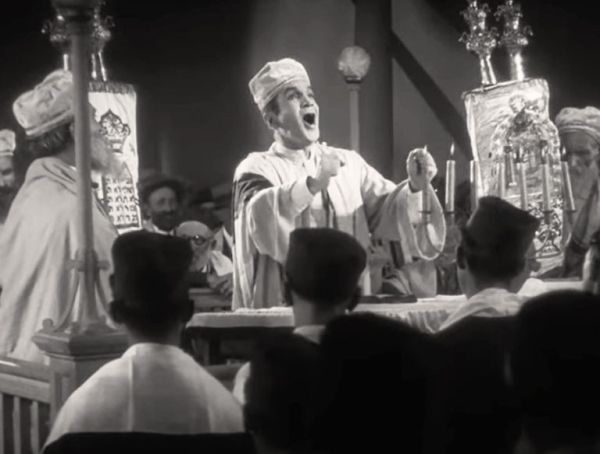
The cantor leads the Yom Kippur “Kol Nidre” prayer in the 1927 Hollywood film “The Jazz Singer”
(screenshot from the film)
The Prayer That Launched the Sound Era of Cinema
The film that ushered in the era of talking pictures was not about an American president, a decisive battle in American history, a detective struggling against all odds to solve a complicated murder, the Wild West, or even a superhero saving the world at the very last moment. Surprisingly, it was a deeply Jewish film, and at its climax, the Kol Nidre prayer is heard.
At the center of the film is the Rabinowitz family, a Jewish family from New York: a couple who immigrated from Eastern Europe and their children, who were born in the United States. The father is a cantor who takes pride in the fact that his family has produced cantors for five generations. He expects his son, Jackie, to follow in his footsteps, inherit his position, and become the sixth generation of cantors.
But Jackie is drawn instead to the new musical style sweeping across the United States in the 1920s: jazz. He dreams of becoming a jazz singer on Broadway.
At the film’s climax, the father lies dying in his bed. At the synagogue, the congregation is waiting for the cantor to lead the Yom Kippur service, while on Broadway the lights are dimmed in anticipation of Jackie’s performance.
At that very moment, the sound of Kol Nidre fills the air.
When Hollywood set out to demonstrate the power of a film that combined actors’ spoken dialogue and singing, making the transition from the silent-film era to the age of sound, it chose to do so with a film centered on a Jewish Yom Kippur prayer.
October 6, 1927 – the evening after Yom Kippur – was a historic day that changed the face of the film industry. That day, New York movie theaters began screening a new film, The Jazz Singer, starring Al Jolson, one of the biggest stars in the United States at the time.
The film is considered a milestone in the history of cinema: the first full-length feature to combine synchronized spoken dialogue with moving images. The film itself even winks at this groundbreakingd evelopment. Early in the movie, when Jolson’s voice is first heard, he says, “Wait a minute, wait a minute. You ain’t heard nothin’ yet.”
The audience in the theater and audiences around the world truly had never heard anything like it before.
Nevertheless, most of the film still unfolded as a silent movie, with only a few minutes of synchronized dialogue. Yet the film’s climax was built not around dialogue, but around a prayer: the Kol Nidre prayer, heard at the end of the film.
That was enough. The film became a huge commercial success, demonstrating to the film industry that talking pictures could be far more than a mere gimmick. Vitaphone, the technology that Warner Bros. had bet on when producing the film, virtually overnight became one of the most important technologies in Hollywood history.
In fact, the integration of sound technology into movies became such an integral part of the film industry that today it is difficult for us to think of the concept of a “film” without also thinking of sound – whether dialogue, a musical score, or special effects.
“My God, this isn’t a Jazz Singer. This is a Cantor!”
But before The Jazz Singer became a successful film, it was a play written by Samson Raphaelson, a Jewish writer born to a family of immigrants from Eastern Europe.
Raphaelson was born in New York in March 1894 to a Jewish family. In 1917, he was a young student at the University of Illinois when Al Jolson came to the university. In addition to being one of the biggest stars of American entertainment, Jolson was himself a Jewish immigrant, born in what is now Lithuania as Asa Yoelson. When Jolson began singing for the students, Raphaelson heard something familiar. Years later, he recalled that his first thought was: “My God, this isn’t a jazz singer. This is a cantor!”
After this encounter, Raphaelson wrote a short story titled
The Day of Atonement, published in 1922.Following the story’s success, he expanded it into a play called
The Jazz Singer.
The play opened on Broadway in 1925 and became a huge success. It starred George Jessel – also Jewish, also born in New York to parents who had immigrated from Eastern Europe.
Raphaelson’s story was more than a drama about the fraught relationship between a son searching for his own path and his dying father. Through the play, Raphaelson also sought to capture the experiences and struggles of Jews of his generation and the tension in which they lived – between maintaining separation and integrating into American society.
On one side was the Jewish home in which they had grown up, which both cherished memories of Eastern Europe and sought to escape the persecution and restrictions that had constrained their lives.
On the other side was the American society around them, offering exciting new possibilities for living their lives and becoming part of the broader culture.
It was an inherent tension that reached its peak every year on Yom Kippur, in the divide between the Jewish community, which came to a complete standstill for a day, and the wider world, which carried on as usual.
Raphaelson did not choose jazz music at random. In his eyes, jazz – a musical form that had emerged in the United States – also served as a symbol of America itself and of life there: turbulent, fast-paced, unpredictable, and restless. Jazz, Raphaelson argued, was a style of music that, like the United States, was still young and searching for its identity.
But Raphaelson saw something else in jazz: Judaism itself. In the introduction to the play, Raphaelson wrote that jazz was a form of prayer. And although jazz is now identified primarily with Black culture, Raphaelson saw it as Jewish music. He pointed to the decisive role played by Jews in shaping jazz and noted that several leading figures in the world of jazz were Jewish. Among them, he cited Irving Berlin, Al Jolson, George Gershwin, and Sophie Tucker. All of them, Raphaelson reminded his readers, were “Jews with roots in the synagogue.”
This three-way encounter between jazz, Judaism, and America was, for Raphaelson, the heart of the story: where do they intersect, where do they collide, and can all three “live under the same roof?”
According to The Jazz Singer, at least, the answer is yes.
Jack does not give up his career as a jazz singer in order to become a cantor for his father, nor does he abandons his family in the name of assimilation into American society. Jack decides to do both: on Yom Kippur, he comes to the synagogue and sings Kol Nidre in place of his dying father. Afterwards, however, he returns to performing on Broadway as a jazz singer using blackface – an issue we will return to later.
In a review of the film published in January 1928, Rabbi Herman Lissauer addressed precisely this tension. The film’s protagonist, he wrote, “was the Jew caught between two worlds, one world dying, and a second struggling to be born.” He went on to say that watching the film reminded him of the home in which he had grown up. He also praised the film as a means of “educating” non-Jews and combating antisemitism.
Rabbi Herman Lissauer’s review in the B’nai B’rith Messenger
,
January 20, 1928. Historical Jewish Press Archive, National Library of Israel
The Sentinel, a Jewish newspaper published in Chicago, likewise remarked on how rare it was to see a play or film in which not only was the Jewish character at the center of the story, but they were also portrayed in such a positive light. “Rarely is a Jewish character presented whose purpose is not to provide comic relief, but rather to portray the Jew as he is, in his true colors.”
The same review reported that the film had already been shown 178 times and had been seen by approximately a quarter of a million people in Chicago alone.
From the Jewish newspaper, The Sentinel,
February 17, 1928
Historical Jewish Press Archive, National Library of Israel
When Sam Warner Bet on Sound – and Died the Day Before the Premiere
When The Jazz Singer was released, Hollywood’s film industry was still in its infancy. Almost all of the heads of the major studios at the time were Jewish immigrants from Europe or the children of immigrants: Adolph Zukor at Paramount, Carl Laemmle at Universal, Louis B. Mayer at MGM, William Fox at Fox, Harry Cohn at Columbia, and the Warner Bros. studio, owned by four Jewish brothers whose original family name was Wonsal.
These men were immigrants or the children of immigrants from similar sociocultural backgrounds who built a new industry and, to a significant extent, helped shape a new American image. Precisely because so many people in this emerging industry were Jewish – a fact that did not escape the notice of antisemites in the United States and abroad – the studio heads were particularly cautious when
choosing subjects for their films and generally avoided explicitly “Jewish” themes. There was, of course, an economic rationale as well: filmmakers wanted to choose subjects that would appeal to the widest possible audience.
Warner Bros., which produced The Jazz Singer, was naturally part of this trend. The four Warner brothers were born to Benjamin and Pearl Warner, Jewish immigrants who had come to the United States from Poland. Of the brothers, it was Sam Warner, born Szmuel Wonsal, who championed the making of the film. He believed that the future of cinema lay in combining film with sound.
At the time, a new technology called Vitaphone was being developed, making it possible to synchronize sound with motion pictures. Hollywood was slow to embrace the new technology, and many in the industry were skeptical. Adding sound to films not only increased production costs; it also required major investments to upgrade movie theaters so that they could accommodate the new technology.
This deterred many in Hollywood.
Sam Warner, however, was among those who recognized the potential of adding sound to movies and pushed for the new technology to be adopted by his family’s studio. Naturally, this called for a film in which sound itself would play a crucial role. Following the success of The Jazz Singer
on Broadway, the Warners decided that its story was particularly well suited to showcasing the new technology, and Sam Warner personally oversaw the production of the
film.
As a result, almost everyone involved in the project – from the studio owner, to the playwright who also wrote the screenplay, to the leading actor himself –was Jewish, with parents who had immigrated to the United States from Eastern Europe, just like the film’s protagonist.
Sadly, Sam Warner did not live to see the film’s premiere.
The day before the film opened, he died of pneumonia, and his three brothers were forced to sit shiva rather than attend the gala premiere.
And so, when the audience heard Hollywood speak for the
first time, the man who had made it possible was not there to hear it.
Is Kol Nidre Too Sacred for the Movies?
In a film designed to demonstrate to the world the capabilities of sound technology and the ways in which sound could influence plot and performance, the question of who would perform Kol Nidre carried particular significance. During production, Warner Bros. approached Yossele Rosenblatt, one of the world’s most famous cantors in the 1920s. The studio believed that his presence was necessary to lend the religious scenes a kind of “kosher certification.”
But Rosenblatt refused.
Kol Nidre, he argued, was too sacred to sing for a movie. The proper place for the prayer, he maintained, was not on the screen but in the synagogue.
In the end, Warner Bros. and Rosenblatt reached a compromise: he did appear in the film, but as himself, in a scene in which he performs Jewish songs that are not prayers. The person who sings “Kol Nidre” in the
film is its star, Al Jolson – a Jew, to be sure, but not a cantor, rather an actor and jazz singer.
In this way, the circle was also completed. Jolson, whose performance had inspired Raphaelson to write the play because his singing reminded him of the prayers he had heard in the synagogue… ultimately became the person who performed the prayer in the film.
Only in Jerusalem: Watching The Jazz Singer Without Sound
More than a year and a half after its American premiere,
The Jazz Singer finally reached movie theaters in the Jewish community in the Land of Israel, under the title
Mezamer Ha-Jazz (“The Jazz Singer”).
Doar Hayom described it as “one of the finest pictures whose subject matter is drawn from Jewish life.”
From the newspaper Doar Hayom - May 13, 1929.
Historical Jewish Press Archive, National Library of Israel
In Jerusalem, the Eden Cinema, which had not yet been equipped to screen sound films, showed the movie accompanied by both a jazz orchestra and a Jewish orchestra.
October 1, 1935.
Historical Jewish Press Archive, National Library of Israel
The connection between The Jazz Singer and Yom Kippur turned the film into something of a mini-tradition at cinemas in the Jewish community in the Land of Israel. From the early to the mid-1930s, the film returned to theaters around the High Holy Days, particularly on the evening after Yom Kippur.
From Haaretz,
September 22, 1936
Historical Jewish Press Archive, National Library of Israel
The Dark Stain on The Jazz Singer
Almost 100 years after its release, The Jazz Singer
is remembered in the United States not only as the first major talking-picture hit, with the now-iconic line “You ain’t heard nothin’ yet,” but also as one of the symbols of the racism that was widespread in early Hollywood. For many, the most prominent symbol of that racism is the use of blackface.
When Jolson performs as the jazz singer on Broadway, he appears in blackface – a practice that was widespread in the entertainment industry at the time, in which white performers painted their faces black to portray Black characters, reflecting the racial segregation of the era. The characters were often portrayed in a degrading or caricatured manner.
The decision to have Jolson appear in blackface, particularly in a film so deeply concerned with questions of identity and the integration of American Jews, has drawn criticism over the years not only for its use of a racist practice, but also for accusations of cultural appropriation.
Ironically, it is not the film’s overt Jewishness that makes contemporary American viewers shift uncomfortably in their seats while watching it, but rather the blackface on Jolson’s face.
The film poster
Whatever the case, on October 6, 1927, the evening after Yom Kippur, when The Jazz Singer premiered in New York, it forever changed the way movies sound. And when Hollywood
first found its voice, it chose to begin with the sounds of the synagogue on the holiest day of the Jewish year.
The “Kol Nidre” prayer begins at approximately 1:28:00, or one hour and 28 minutes into the film.
André Bourbeau
The Jazz Singer (Crosland, 1927) — High Quality 1080p The 1080p