Ever since Mom’s funeral, I have been pursuing a mystery of the origins of “The Love of God.” I've gone down several false paths that fooled me for a while and ultimately led to dead ends. But I think I have at last uncovered its thousands of years of history, and I’m thinking, I just have to share this with family. You may recall the lyrics of the third verse:
Could we with ink the ocean fill,
And were the skies of parchment made,
Were every stalk on earth a quill,
And every man a scribe by trade;
To write the love of God above,
Would drain the ocean dry.
Nor could the scroll contain the whole,
Though stretched from sky to sky.
The origins go back to antiquity. It was recited back in the days of the Second Temple and quite commonly inspired personal writings, not only about God, but also other subjects. For example, when asked about his relationship with the Great Rabbi Hillel, Rabbi Johanan ben Zakkai (30 AD- 90 AD) responded:
“If all the heavens were parchments, and all the trees quills, and all the seas were ink, it would still be impossible to write down even a part of what I learned from my teacher.”
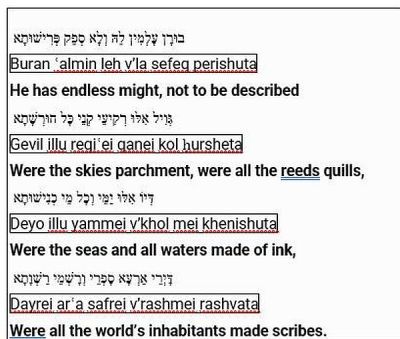
A turning point came when the poem was put to music by a Rabbi and Cantor from Worms in the 11th century named Meir Ben Isaac Nehorai.
|
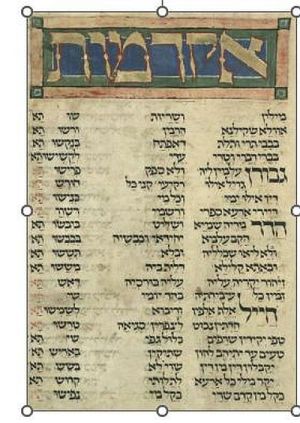
The popularity of his version led to its inclusion as part of a longer liturgical poem/song called Akdamut. Akdamut means scholarly or academic, and is part of the phrase "Akdamut Milan", or "Scholarly Words" or (due to grammatical detail) "Introduction to the Words [of the Ten Commandments]." It is written in Jewish Babylonian Aramaic. Believe it or not, this Akdamut is STILL recited today by many Ashkenazic Jews as the introduction to the Torah Portion on Shavuot (the Holy Day where we celebrate God giving the commandments to us at Mt. Sinai). Below is a copy of this longer version from the Mahzor of Worms, a 13th-century illuminated manuscript.
If you want to hear it sung in Aramaic, here is a link. It is at the beginning of the video, just after the first pause. https://www.youtube.com/watch?v=knpvQNPgjkA
|
|
Over time, the word "Akdamut" became mispronounced as "Hadamut." That is the name which today refers to to Rabbi Nehorai's poem, which is also sometimes called "Hadamut Nehorai."
Fast forward in time to 1917. Two Christian songwriters, F.M. Lehman and his daughter, Mrs. W.W. Mays, were working on a new hymn entitled The Love of God. They had completed two verses when they came down with a case of writer’s block. At that time, as a reflection on the Trinity, hymns had to have three verses. It looked like "The Love of God" was doomed to be forgotten.
Then, during their travels in Germany, the father and daughter came across an insane asylum and talked to some guards who had examined the cell of a patient that had recently died. This patient (most likely Jewish since he was familiar with the Hadamut) had written on the wall in English in a moment of lucidity:
Could we with ink the ocean fill,
And were the skies of parchment made,
Were every stalk on earth a quill,
And every man a scribe by trade;
To write the love of God above,
Would drain the ocean dry.
Nor could the scroll contain the whole,
Though stretched from sky to sky.
Lehman and Mays were moved, and they also saw that the meter matched that of "The Love of God." They adopted it as "their" third verse, and "The Love of God" was published in 1920.
For decades it was a beloved hymn for many, many Christians, who had NO IDEA in the third verse they were singing a Jewish song!
Even though the style of Christian music has switched from Hymns to Praise Music, the song is STILL AROUND. In 2007, a version was sung by Mercy Me. Their arrangement is available on many YouTube sites, including one with 2.3 MILLION views.
And THAT is the version Carol had played at Mom’s funeral. The link is below if you want to walk down memory lane.
https://www.youtube.com/watch?v=oWnvmKoLWUU
