THE PRODIGAL SON
A. C. RosenthalFrom: acrosenthal+the-god-question@substack.com
The Lame Ox
THE GOD THEY REJECTED ISN’T REAL series 50-75
A. C. Rosenthal
October 6, 2026
THE PRODIGAL SONA. C. RosenthalFrom: acrosenthal+the-god-question@substack.com The Lame Ox THE GOD THEY REJECTED ISN’T REAL series 50-75 A. C. Rosenthal October 6, 2026 |
|
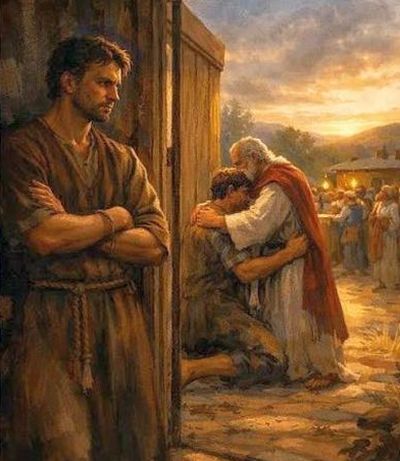
The Biblical Parable (Luke 15:11–32)
• The Story: A younger son asks his father for his inheritance early, leaves home, and wastes all his money on reckless living.
Wisdom International
Two Prodigal Sons
September 12, 2023 by Stephen Davey
Scripture Reference: Luke 15:20–32
Series: The Journey Through The Gospels
https://www.wisdomonline.org/wisdom-journey-episode-detail/two-prodigal-sons/?gad_source=1&gad_campaignid=23899768529&gbraid=0AAAAAoOXm14uxztFp0sJy2jw785kKJpgA&gclid=CjwKCAjw56zWBhB0EiwAdPOQOY84r00TAHSF6T-sE7-gatrONZ-C-H2m3MtxXlOg52HzLX00xdtUbhoCBjsQAvD_BwE
Two Prodigal Sons
Luke 15:20–32
Lesson 442 Transcript
The story of the prodigal son is perhaps Jesus' best-known parable. Yet as familiar as we might be with it, we think of it as the parable of the prodigal son. However, this is really a parable of two prodigal sons.
Both sons are lost—one son becomes a prodigal when he runs away from home; the other son is a prodigal while staying at home. Both sons defy their father’s wishes. Both sons break their father’s heart. The father leaves the house in order to find both of them. In fact, both of them need to be found.
"While he [the prodigal son] was still a long way off, his father saw him and felt compassion, and ran and embraced him and kissed him." (Luke 15:20)
“[the elder son] These many years I have served you, and I never disobeyed your command, yet you never gave me a young goat, that I might celebrate with my friends. But when this son of yours came, who has devoured your property with prostitutes, you killed the fattened calf for him!” (Luke 15:29–30)
About this lesson.
Luke 15 closes with a parable not of one prodigal but of two—a runaway son and a rule-keeping son, both equally lost and both equally in need of the Father. The Father races out to meet each of them, picturing the grace of a God who seeks sinners and welcomes them home.
A. C. Rosenthal
From: acrosenthal+the-god-question@substack.com
The party in the parable lasts one night. What the father is actually asking of his older son will take forty years, and nobody preaches it because it happens after the story stops.
I. A statement of accounts
The father’s answer to the son standing outside the party is usually read as consolation. A pat on the shoulder, a there-there, a reminder that he is loved too.
It is not that. It is a statement of accounts, and it is more brutal than the complaint it answers.
He says: my child, you are always with me, and all that I have is yours.
Every word of that is legally exact and the elder son knew it, which is why he does not argue with it. To see what he heard, the property arrangement has to be reconstructed, and the parable gives enough detail to do it.
II. The division already happened
The younger son asks for the share of the estate that will fall to him, and the text says the father divided his living between them.
Two details in that sentence are load-bearing and both are usually skipped.
The word for living is bios, meaning the means of life, the working estate rather than a cash sum. And the father divided it between them, plural, which means the elder son’s share was allocated at the same moment.
Under the inheritance rule in Deuteronomy the firstborn received a double portion. Two sons therefore split three ways, with two thirds to the elder and one third to the younger.
The younger took his third, liquidated it, and left. The elder son’s two thirds were never handed over as cash and never could have been, because an ancient estate is land and herds and vines and a household, and dividing it physically would destroy it. His portion stayed in the ground and in the flocks, legally his, worked by him, held undivided until his father died.
Which means the elder son had been the owner of two thirds of everything he touched for the entire period of his brother’s absence.
The goat he never received was his goat. It had been his goat the whole time. He had been asking permission for something he already owned, and had spent years waiting for a man to give him what the man had already given him, and had built a grievance out of the waiting.
That is the first thing in the father’s sentence and it is not comfort. It is the discovery that the account he had been keeping was against himself.
III. Whose calf was killed
The second thing is worse, and once seen it cannot be unseen.
The fatted calf came from the herd. The herd was part of the estate. Two thirds of the estate belonged to the elder son by law and by the division his father had already performed.
The father has just slaughtered his elder son’s calf for the younger son. The robe came from the household stores, the ring came from the household, the sandals and the musicians and the food came out of holdings that were, in the strict legal sense, the property of the man standing in the field refusing to come in.
He is not objecting to a party. He is objecting to being billed for it.
The father, saying all that I have is yours, is not softening that. He is confirming it. Yes. It was your calf. It came out of your two thirds. I spent your property on your brother without asking you, and I would do it again, and I am telling you so to your face while the music is still playing.
The complaint in the previous essay was accurate and the father conceded every word of it. This is what he concedes it with. Not a denial and not an apology. An acknowledgement that the cost was real, that it was borne by the son who stayed, and that it was worth it.
IV. What tomorrow looks like
Now the part that is never preached, because the parable ends and the reader is left with the music.
The music stops. Everyone goes to bed. In the morning both sons get up and go out to work, and the arrangement they go out into is permanent.
The younger son has nothing. His third is gone, spent in the far country, and there is no mechanism by which he gets another. Inheritance was a single event and it had happened. He cannot be given a second portion without taking it from his brother, and the father does not do that.
He comes home to live and work on an estate that is entirely his brother’s, as a permanent dependent, for the rest of his life. He eats his brother’s bread. He works his brother’s fields. When their father dies, and he will, the whole thing passes to the elder son and the younger one continues exactly as before, at his brother’s discretion.
The two men who used to walk out to the fields as co-heirs will walk out tomorrow as owner and kept man.
That is the arrangement the father is asking his elder son to accept. Not for an evening. Forever, and every morning, and without ever once letting the younger man feel it.
V. The Lame Ox
The temptation will not arrive as a crisis. It will arrive as a Tuesday.
It is the middle of the afternoon in the hot part of the year. The two brothers are working a field together, and one of the oxen has gone lame, which means the work will take twice as long and the day will end after dark and both of them are already tired.
There is a sentence sitting in the elder brother’s mouth, and it is completely true, and it would cost him nothing to say it.
We used to have two teams.
That is all. Six words. Not an accusation, not a fight, not even raising his voice. A factual observation about the history of the family’s livestock, delivered while looking at a lame animal, in the hearing of the man who sold the other team and drank the money.
The younger brother would have nothing to say to it, because there is nothing to say to it. It is true. He would just carry it for the rest of the afternoon and the rest of the year and the rest of his life, and he would understand exactly what had been said and why.
That sentence is available to the elder brother every day for forty years. Some version of it is available every time a tool breaks, every time the harvest is thin, every time they are short-handed, every time anything at all goes wrong on a farm, which on a farm is daily.
The hardest part of the instruction is that he would never have to say it more than once. The first time would establish the arrangement permanently, and after that a glance at a lame ox would be enough, and the younger brother would flinch at oxen for the rest of his life.
What the father is asking is not that his son forgive an event. It is that he decline, on an unremarkable Tuesday, in front of a lame animal, to use a true sentence that is sitting right there.
Every day. For decades. With no audience, no credit, and nobody to know he did it.
Notice also what the father does not offer, because the omission is the point.
He does not restore the third. He could. The estate is his until he dies and he has already demonstrated that he will spend it as he likes. He does not top the younger son back up to parity, and he does not compensate the elder son for the calf, and he does not propose any arrangement under which the books eventually balance.
What he says instead is that his son was dead and is alive, was lost and is found, and that it was fitting to celebrate.
Fitting. Not necessary, not obligatory, not a duty owed. The word carries the sense of what the occasion called for, which means the father is making an aesthetic and moral judgement about proportion, and telling his elder son that the accounting frame is the wrong instrument for measuring what happened.
A man came back from the dead. Against that, a calf.
The elder son’s arithmetic is not wrong. It is being told that it is the wrong operation, on the wrong quantity, in a situation where arithmetic does not apply, and that is a far harder thing to be told than that you have added it up incorrectly.
That is what all that I have is yours costs, and the cost is not the calf.
VI. Who reached the road first
There is a version of this parable that did not happen, and a great many people have lived inside it.
The younger son comes up the road with a speech prepared. Every word of it is worked out in advance, and the last line is the operative one. Make me as one of your hired servants.
He never gets to say it. The father cuts him off before the sentence lands, with the robe and the ring and the shoes, and the transaction the son came to propose is refused before it can be tabled.
Now change one detail and run it again.
The elder brother is in the field. On any ordinary day he is closer to the road than the house is. He is the one who would see a figure coming from a distance, and the parable has already told us, in his own words, what he calls that figure.
This son of yours.
Not my brother. He performs the excommunication out loud, in front of his father, and he does it at the moment of the man’s return rather than at any point during the years of his absence.
Had he reached the road first, the boy would have got exactly the arrangement he came prepared for.
He would have accepted it, too, and that is the worst part of the counterfactual. He had rehearsed hired servant on the way home because he believed it was what he deserved, and a man who already believes that will accept the verdict from the first person in the household who offers it. He would have gone to the servants’ quarters carrying a judgement his brother issued and his father never made, and he would have spent the rest of his life inside it, and he would never have known there had been another option.
The father was watching the road for years. He was not only watching for his son. He knew what was standing between the road and the house, because he had been living with it, and the son in the field had not been hiding it.
The tragedy in this has a specific shape and it is worth naming precisely.
The elder brother is not lying. Everything he says about his brother is true and he has the receipts. He knows what was spent and on what and with whom, and no part of his account is exaggerated. What he lacks is not accuracy. It is standing. The estate is not his to allocate while his father is alive, and he issues verdicts on his father’s behalf that his father has never authorized and would not sign.
Jesus said this directly to the men he was telling the story to, and the language is not gentle. He told them they shut the kingdom of heaven in people’s faces, and that they neither went in themselves nor let others in who were trying to.
Not that they had bad theology. That they were standing in a doorway.
Which is the reason the father goes out twice and sends nobody. He goes down the road himself for the younger son, and out of his own party into the field for the elder one, and both times he leaves the house rather than dispatching a servant or a message or the other brother.
A great many people have gone up that road. They had a speech ready and a number in mind for what they would settle for. The first person they met was in the doorway, and told them the terms, and the terms were accurate about what they had done and had no authority behind them whatsoever.
Anyone who was met that way should know two things. The verdict was real and it was not the father’s. And the man in the doorway was not the owner, whatever he believed about the calf.
VII. Seventeen years of it
Scripture contains one extended account of exactly this arrangement and it runs for a third of Genesis.
Joseph’s brothers threw him in a pit, discussed killing him, sold him to a passing caravan, and lied to their father about it for more than twenty years. This series has looked at his time in Egypt before, as a study in preparation. What happens afterwards is a different story with a different problem, and the problem is the one in section five.
He ends up in charge of the food supply of the ancient world during a famine. His brothers come to buy grain and do not recognise him. He tests them, reveals himself, weeps loudly enough that the Egyptian household hears it, and brings the entire family down to live in Goshen.
The narrative then reports something readers race past. Jacob lived in Egypt seventeen years.
Seventeen years of the arrangement. The brothers who sold him living on land he allocated, eating grain he controlled, in a country where he was the second most powerful man alive and they were resident foreigners with no standing whatsoever. Seventeen years of him having the sentence available every single day, and considerably worse sentences than six words about oxen.
He does not appear to have used it. Nothing in the record suggests he did.
Jacob dies, and Genesis 50 shows exactly how much good seventeen years of restraint had done.
The brothers panic. They say to each other that Joseph may now hate them and pay them back for all the evil they did to him. They send him a message claiming their father left instructions that he should forgive them, which is a fabrication and reads like one, and then they come and fall down in front of him and offer to be his slaves.
Seventeen years, and they still thought he had been waiting.
That is the detail. Not that they were ungrateful, but that they could not believe it. A man who has held total power over you and not used it for seventeen years, and the moment the buffer between you dies you assume the whole thing was a performance and the bill is now due.
Joseph weeps when the message arrives. The text says so and does not explain it, and the reason is not hard to reconstruct. Seventeen years of not saying the sentence, and they had been braced the entire time.
What he says to them is the answer to the elder brother’s question, arriving from four hundred years earlier.
He asks whether he is in the place of God. He tells them that they meant evil against him and that God meant it for good, to keep many people alive. And then, the text says, he comforted them and spoke kindly to them, which in Hebrew is literally that he spoke to their hearts.
He does not say it was fine. He says they meant evil, in those words, to their faces, and the sentence he refuses to use is a sentence he has just demonstrated he could construct perfectly well.
That is the whole distinction. Not pretending the ox was never sold. Declining to bring it up.
One detail in the Joseph account makes the cost visible, and it is easy to miss because it is in a list of names.
He had two sons in Egypt, before the famine and before the brothers arrived, and he named them himself. The first he called Manasseh, which the text explains as meaning that God had made him forget all his hardship and all his father’s house. The second he called Ephraim, because God had made him fruitful in the land of his affliction.
A man does not name a child forgetting unless he is working at it. And he does not call the country where he is second in command the land of his affliction unless something in him is still keeping the account he has decided not to present.
Joseph was not serene. He was a man who had to name his own children after the effort, and who wept every time his brothers appeared in front of him, four separate times in the narrative, including the last one.
The restraint is not the absence of the grievance. It is the grievance, carried, at cost, and set down every morning.
VIII. The objection
The serious version is that this essay is a recipe for a doormat.
Telling a wronged man to hold total power over the person who wronged him and never mention it is not forgiveness, the objection runs. It is the suppression of a legitimate grievance, dressed as virtue, and the psychological literature on suppression is not encouraging. Unexpressed resentment does not evaporate. It goes somewhere, usually into the body or into somebody else, and a household running on it is worse than one where things get said.
The objection is right about suppression and wrong about what is being described.
Suppression is holding a grievance and hiding it. The father is not asking for that, and the parable is precise about it. The son says the whole thing out loud, in the field, at volume, with the accusation about prostitutes included, and the father stands there and takes it and does not tell him to lower his voice. Nothing is suppressed anywhere in the scene.
Joseph likewise. You meant evil against me. Said plainly, to their faces, at the moment of maximum leverage.
What is being asked is narrower than suppression and harder. Say it once, to the person’s face, in full, and then decline to use it as an instrument afterwards. The grievance is not denied and not buried. It is disarmed.
A man who has never said it is suppressing. A man who says it every time the ox goes lame is using it. What the father wants is the third thing, and the third thing is rare enough that most people have never watched anybody do it.
IX. Thursdays
On the second of October in 2006 a milk truck driver named Charles Roberts walked into a one-room Amish schoolhouse near Nickel Mines in Lancaster County, sent out the boys and the adults, barricaded the door, and shot ten girls between the ages of six and thirteen. Five of them died. He killed himself as the police came through the windows.
What the Amish community did in the following days is reasonably well known and is usually where the account stops.
They went to the killer’s family within hours. A grandfather of one of the murdered girls said of Roberts that they must not think evil of this man. They visited his widow and his parents. Around thirty of them attended his funeral, and at the graveside they stood in a half circle around his widow so that she would not have to face the press alone. They set up a fund for his children.
All of that happened inside a week, and inside a week is the easy part, and the community has said so.
The part that belongs in this essay happened afterwards and took eleven years.
One of the surviving girls, Rosanna King, was six. She was shot in the head and lived. She cannot walk or talk. She uses a wheelchair, is fed through a tube, and requires care that does not end.
Terri Roberts was the killer’s mother. She lived a few miles away, in the same rural county, and had to go on living there.
The King family invited her to help care for their daughter.
She went, on Thursdays, for eleven years, until her own death from cancer in 2017. She bathed the girl. She read to her. She dried her hair. She sat with her so that the family could do something else for a few hours.
The arrangement runs both ways, and it is the parable with the roles filled in.
The Kings hold every card. Their daughter cannot speak because of that woman’s son. Nothing they could say to Terri Roberts would be unfair. The equivalent of the lame ox was in that house every hour of every day, in a wheelchair, needing to be turned.
Terri Roberts spent eleven years walking into the house of the family her son destroyed, knowing that the whole thing was available to be said, and that they had never once said it.
She wrote afterwards that the forgiveness came before she had done anything to deserve it and that she spent the rest of her life inside it rather than getting over it. Which is what living on somebody else’s estate feels like when the owner has decided you eat.
Two things should be said plainly rather than left for a critic.
The Amish practice of forgiveness is bound up with a community structure that also carries real costs, including shunning, and outsiders have raised fair questions about how freely a member could decline to forgive. The scholars who did the fieldwork raise it themselves. Whatever is being described here is not a technique that transfers cleanly to a person with no community and no tradition.
Forgiveness in that community is also not a feeling. Every account from the fieldwork says the same thing: it was a decision made immediately, as a matter of obedience, with the grief left entirely intact and running for years afterwards. Nobody claimed to have stopped hurting.
X. Count them
The parable ends with the father in the field and the older son not yet moved, and the reason it ends there is that everything after it is the part nobody can do for him.
Nothing about the work changes. He is up before dawn either way, the same fields, the same herds, the same lame ox in the hot part of the year, the same brother alongside him who cost the family a third of everything and is now eating at his expense.
The only variable is whether he runs the place as a hired man keeping accounts against his brother, or as an owner who has decided the man eats.
Same field, same day, same brother. The difference is entirely interior and it will never be visible to anyone, and it will have to be chosen again every morning for the rest of his life.
There is an old hymn about this and it is usually dismissed as sentimental, and it was written by a man selling insurance in New Jersey, and the instruction in it is exactly right.
Count your blessings. Name them one by one.
Not feel grateful, which cannot be commanded. Count, which can. Go through the actual inventory, out loud if necessary, on the specific Tuesday when the ox is lame and the sentence is sitting in your mouth.
The estate is yours. The herd is yours. The house is yours. Your father is alive and standing in front of you asking you for one thing.
Your brother, who was dead, is at the other end of the field, holding the yoke of the lame animal, waiting for you to say something.
The father block closes here. Two threads stay open. The first is where the picture of God most people are actually carrying came from, which is rarely the Bible and almost always the culture, and that is next. The second was promised earlier and is still owed: what happens to the person who did wait, who did keep the rules, and who lost the years anyway. There is a promise in Joel about the years the locust ate.
This one is public. Share it with anyone who would rather check than be told.
A. C. Rosenthal writes on comparative religion, Islamic theology, and the relationship between Christianity and modern Western culture. The work is entirely reader-supported, which is the only reason it can say what it says.
Books: The Two Muhammads: What History and Manuscripts Reveal About the Islamic Dilemma, The God They Rejected Isn’t Real: Exposing the False Gods of Modern Doubt, and The Carpenter’s Son and the Imam’s Son.
acrosenthal.com thetwomuhammadscurriculum.thinkific.com
Sources:
Scripture: Luke 15:11 to 32, with 15:12, 15:19, 15:30 and 15:31 carrying the argument; Matthew 23:13; Genesis 37, 41:50 to 52, 45:1 to 15, 47:28, and 50:15 to 21; Deuteronomy 21:15 to 17. Quotations follow the ESV and NIV.
Bailey, Kenneth E., 1992. Finding the Lost: Cultural Keys to Luke 15. Concordia.
Bailey, Kenneth E., 2008. Jesus Through Middle Eastern Eyes. InterVarsity Press.
Snodgrass, Klyne, 2008. Stories with Intent: A Comprehensive Guide to the Parables of Jesus. Eerdmans.
Nolland, John, 1993. Luke 9:21 to 18:34. Word Biblical Commentary, volume 35B. Word Books.
Wenham, Gordon J., 1994. Genesis 16 to 50. Word Biblical Commentary, volume 2. Word Books.
Alter, Robert, 1996. Genesis: Translation and Commentary. W. W. Norton.
Sarna, Nahum M., 1989. Genesis. JPS Torah Commentary. Jewish Publication Society.
Westbrook, Raymond, 1991. Property and the Family in Biblical Law. Sheffield Academic Press.
Kruse, Thomas, and others, on partible inheritance and the double portion in ancient Near Eastern practice; see also Milgrom, Jacob, 1990, Numbers, JPS Torah Commentary.
Kraybill, Donald B., Nolt, Steven M., and Weaver-Zercher, David L., 2007. Amish Grace: How Forgiveness Transcended Tragedy. Jossey-Bass.
Kraybill, Donald B., Nolt, Steven M., and Weaver-Zercher, David L., 2010. The Amish Way: Patient Faith in a Perilous World. Jossey-Bass.
Roberts, Terri, with Wagner, Jeanette, 2015. Forgiven: The Amish School Shooting, a Mother’s Love, and a Story of Remarkable Grace. Bethany House.
Lancaster County Coroner and Pennsylvania State Police reports on the West Nickel Mines School shooting, 2 October 2006.
Ruth, Andrea, and Associated Press coverage of Terri Roberts and the King family, 2013 to 2017.
Oatman, Johnson, Jr., 1897. Count Your Blessings. Music by Edwin O. Excell.
Genesis 41:50 to 52, on the naming of Manasseh and Ephraim.
Wegner, Daniel M., 1994. Ironic Processes of Mental Control. Psychological Review, volume 101.
Entries 10 and 15 consolidate several sources and their bibliographic details are reconstructed rather than verified.
© 2026 A. C. Rosenthal - 548 Market Street PMB 72296, San Francisco, CA 94104
The adjective prodigal describes someone who spends money or resources recklessly, wastefully, or extravagantly.
Core Meanings; Spendthrift or Extravagant (Primary Definition)
Meaning: Wastefully lavish; squandering money, time, or talents without foresight.
Example: "His prodigal spending habits left him with nothing by the age of thirty."
Returning Home (Common Modern Misconception)
People often assume prodigal means "returning after a long absence" or "repentant." This is a slight misconception driven entirely by the biblical story of the Parable of the Prodigal Son.
In the story, the son is called "prodigal" because he wastes his inheritance on foolish living, not because he comes back home—though his eventual return is what makes the story famous.
Return To The Literary Index Return To The Site Index Page Email Shlomoh at kingsolnew@yahoo.com